Systems of Misrepresentation
taking the victim-blaming out of schema assessment and therapy

An interaction from my adolescence:
MOTHER: (from upstairs) Tree!
ME: Yeah? What’s up?
MOTHER: (louder) Hey Tree!
ME: (goes to doorway and calls back more loudly) Yeah! What is it?
MOTHER: (yelling) TREE!
ME: (goes to bottom of stairs and calls up loudly) What do you need?!
MOTHER: What’s with the fucking tone?!
ME: What? I didn’t have a--
MOTHER: YES YOU DO! LOSE THE FUCKING ATTITUDE!!!
ME: OH MY GOD! WHAT DO YOU WANT FROM ME?!
MOTHER: Nothing now! Nevermind. Guess I have to do everything in this house myself…
….later that day….
MOTHER: (on the phone) ...No, it’s not just her being a kid. She’s just lazy and ungrateful. I swear to God if I packed up my bags and left right now then no one would even notice until they got hungry…
ME: (frozen in shame on the stairs)
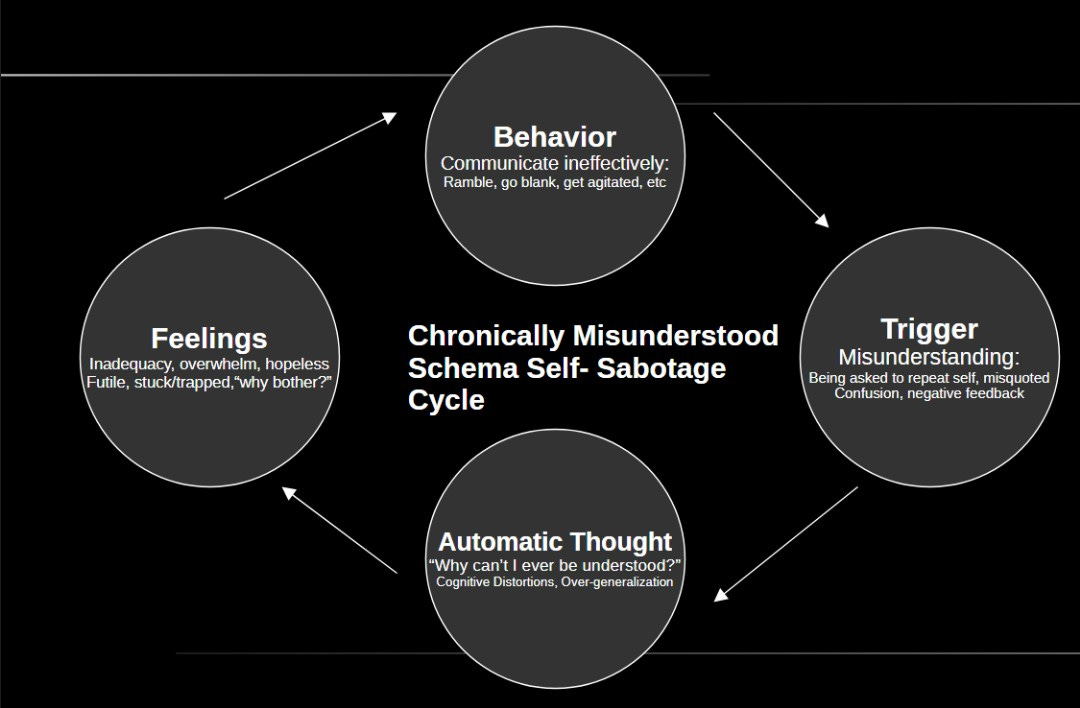
There’s a significant population of people in our society who hold the core trauma of being chronically misunderstood. Related to this core wound is another similar trauma: that of being chronically misrepresented. The two are related in that misrepresentation can follow a misunderstanding, but misrepresentation can also carry with it the weight of being intentionally inflicted upon a person. This creates further complex issues with trust and fear of rejection, as well as social instability and isolation.
There are two main obstacles to healing for those with chronic misrepresentation trauma. Firstly, the individual may not be able to easily opt out of participation in communities and social systems where misrepresentation has already taken place. Therefore, they may continue to face further reinforcement of the misrepresentation trauma in their day-to-day interactions with friends, family, colleagues, doctors, etc. Since trauma healing requires safety, security, and validation, the individual’s environment may become a significant barrier to healing, filled with constant reminders of their pain and actual re-traumatization. Secondly, current strategies for addressing trauma focus on equipping the suffering individual with resources and skills for better emotion regulation, mindfulness, distress tolerance, and interpersonal effectiveness. For obvious reasons, in many cases, increasing a person’s mastery of these skills can help them mitigate the number of misunderstandings in their life and therefore help to heal the trauma of being chronically misunderstood over time. But can the same be said for individuals who are trapped within systems of misrepresentation?
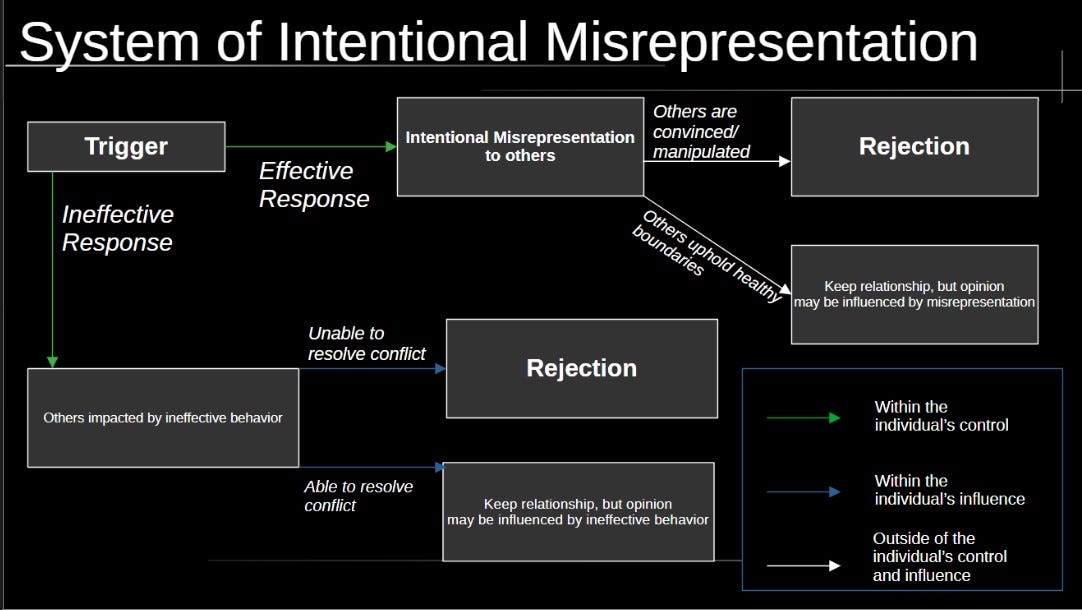
The function of a system is what it does: systems of intentional misrepresentation disrupt effective relationships
When misrepresentation is inflicted intentionally or results in actual abandonment and rejection of an individual, a very real betrayal has taken place. A betrayal is not an emotion or a feeling; it is a situation. Real harm was done that needs to be addressed before the person can even begin to heal, and if others are complicit in inflicting any of that harm then they are obligated to take part in healing it. In cases of misrepresentation, where the truth has been distorted by accident or intention, the truth needs to be found again. When rejection and abandonment have resulted from the misrepresentation of a person, those relationships need to be brought back to a place of mutual acceptance and respect, even if they cannot be restored fully. In some cases, intentional misrepresentation can be a violation of a person’s sense of safety, security, and autonomy. As such, it requires some form of interpersonal justice to be restored in order for that environment to be safe for the affected individual to remain in. After all, if we equip individuals to stay in their systems of residence and if the people in that system are committed to perpetuating the misrepresentation of the traumatized individual (despite their increasing mastery of emotional regulation, mindfulness, distress tolerance, and interpersonal effectiveness skills) we would be encouraging them to remain in an environment that is intentionally causing them harm.
It is necessary then, to differentiate between the trauma schema of the chronically misunderstood and the chronically misrepresented, and even further between misrepresentation trauma that is intentionally and accidentally inflicted. To this end, one can enter self-sabotaging cycles of misunderstanding and accidental misrepresentation. Poor emotion regulation and interpersonal skills will inevitably create more misunderstandings, which in turn create opportunities for accidental misrepresentation.
One cannot, by definition, enter a self-sabotage cycle of intentional misrepresentation. It is not the individual’s “self” who makes the majority of ineffective decisions in these systems. These are cases when others within a system are enacting the misrepresentation of the individual regardless of effective communication and emotional regulation. This individual is in need of healing, yes, but first, they are in need of an exit from a harmful system and a no-win situation. Methods of healing/treatment/support that fail to address these actual needs will result in wasted time and energy and prolonged exposure to harm.
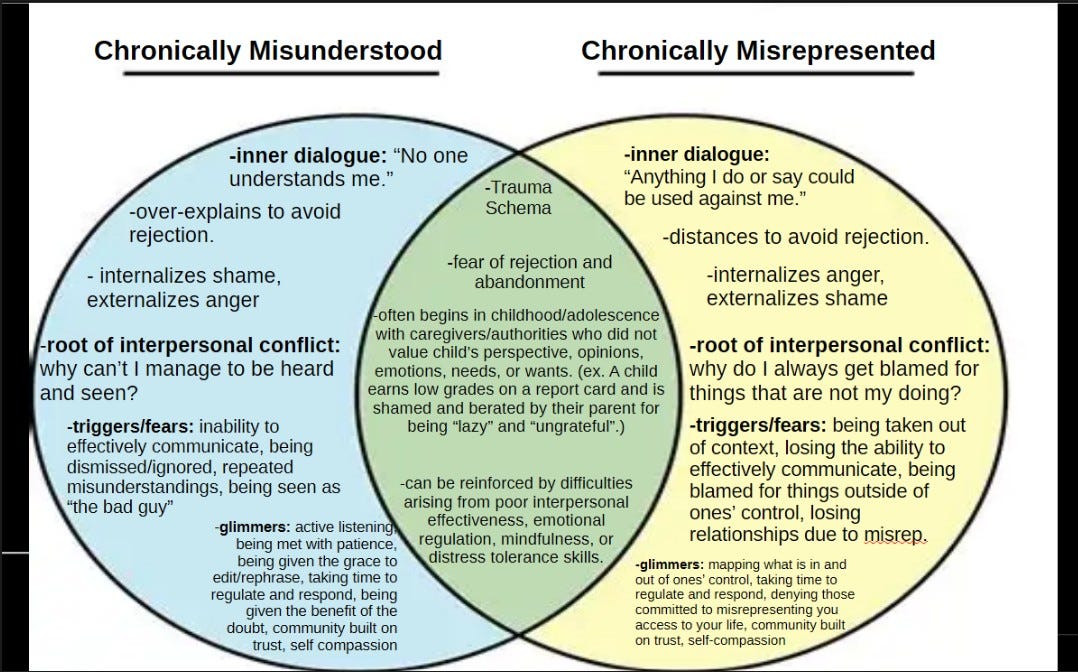
In more simple terms, someone with a core schema of being chronically misunderstood may wonder aloud in vulnerable anguish “am I defective?” while the person who has been chronically misrepresented may spiral into crisis once they finally burst out with “do I really deserve to be blamed for this?” after a prolonged conflict with loved ones. This schema can promote survival strategies of emotional repression, defensiveness, evasiveness, guardedness, and perfectionism. These behaviors are intended to avoid rejection and abandonment by decreasing the opportunities for misunderstandings, but within systems of misrepresentation, even the most developed strategies fail.
This is because, within these systems, the affected individual has control over very few decisions and situations, since they are not the only active participant. Their choices are limited to having an effective or ineffective response to a trigger, and the subsequent interactions that arise from there. They do not get to control how others interpret their behavior or responses. They do not get to control whether or not others choose to misrepresent their actions to people in their life. They do not get to control whether those people believe the misrepresentation, and they do not get to control whether those people choose to reject them, or choose to perpetuate the harm in turn.
Therefore, when interacting with the healing of chronic misrepresentation trauma, we must first identify any current systems of misrepresentation causing recurring trauma. If these systems are arising accidentally, they may be improved over time through the mastery of DBT skills and other proven treatments. If these systems are intentional, then the priority should be the creation of effective boundaries between the individual and the harmful system(s) and the establishment of healthier, more functional relationships and support systems.
Lastly, it is true that the self-sabotage cycles of the chronically misunderstood can and do exist within systems of intentional misrepresentation, and at times give rise to such systems. But often, the cycles that are most integral to a system are outside of the most affected individual’s control. Let’s look again at the example scenario from the beginning, and map out the self-sabotage cycle:
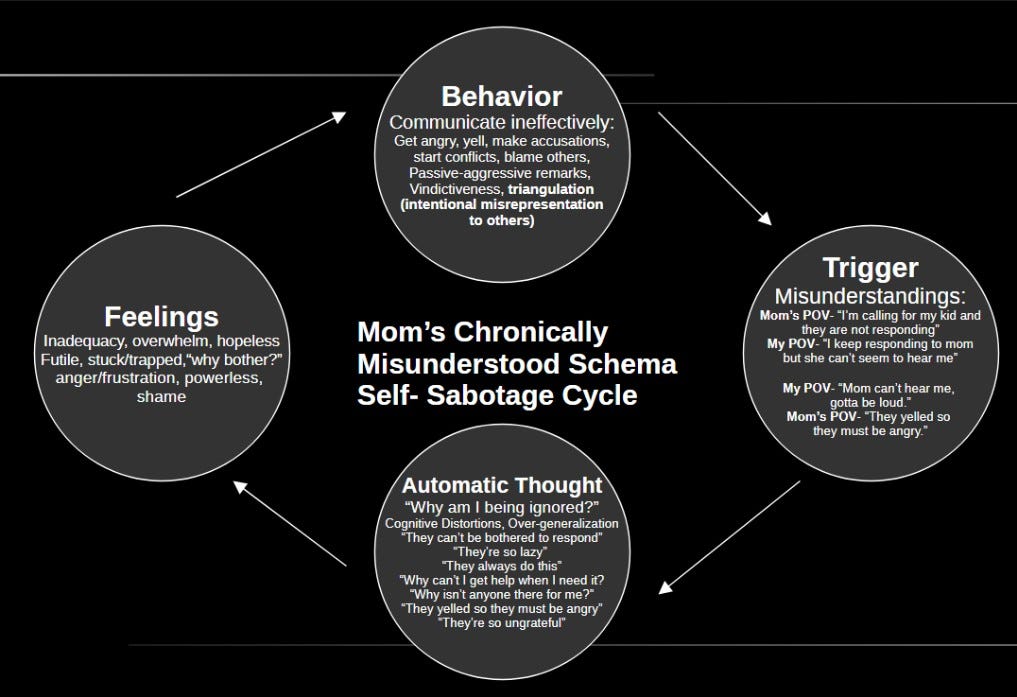
From this we can see the relationship between the triggers, thoughts, feelings, and actions that make up the self-sabotage cycle exemplified in the scenario. But we can also identify the point where a system of intentional misrepresentation may arise from the ineffective behavior of triangulation in response to a misunderstanding or conflict. The choice to engage in this ineffective behavior is outside of the impacted person’s control. Therefore, unless the person who is habitually engaging in triangulation is also willing and able to participate in the healing and restorative justice processes with the impacted individual, approaches that focus primarily on improving the skills and tolerances of that impacted individual will ultimately fail.
To those who are in the position to have to determine the details of a person’s life and psyche from the symptoms and narratives presented and decide a course of action, I do not envy your seemingly impossible task. It seems that the mere process of assessing for these schemas can inadvertently reinforce or trigger the core trauma. I hope that my understanding of these experiences can provide helpful insight so that more people may find healing (and make up for how much of a challenge I have been as a client)
Chronic Misrepresentation Schema Assessment suggestions:
(rate 1-6)
There isn’t anyone in my life I can trust to keep an embarrassing but harmless secret.
I will lose the respect and acceptance of those I care about if they hear gossip about me.
My interpersonal conflicts tend to be limited to a certain type or number of relationships, instead of across all areas of life. (family, friends, romantic relationships, hobbies, work, etc.)
During conflict, I am often blindsided by accusations that feel exaggerated or out of nowhere, or come from people who were previously uninvolved.
During conflict, I often feel bewildered and trapped in no-win situations.
People in my life have zero tolerance for immaturity, mistakes, or bad behavior.
The expectations that people have of me are unfair; I do not hold those perfectionist standards for others.
No matter how hard I try, I cannot seem to please the people in my life.
If I make a mistake in public, I expect or fear that people will talk about it and judge me in secret.
I refuse to give apologies when I perceive them as unnecessary or unwarranted.
In past conflicts, uninvolved people got upset with me over the things someone told them.
There are people in my life who often speak badly of me to others.
There are people in my life that I can never be good enough for.
No matter how strong the relationship is, I might be suddenly abandoned if they hear the wrong kind of information about me.
Even if the gossip isn’t true, it can still ruin everything.
If I make a mistake and it impacts someone, they will speak badly about me.
There are people in my life that I have caught talking about me negatively behind my back.